नव लीला — nine stories from the life of Shyam. The same Krishna the bhajans address: born in a prison, raised among cowherds, beloved of the gopis, slayer of a tyrant, friend of a poor Brahmin.
Leela I
The Midnight Birth
जन्म लीला
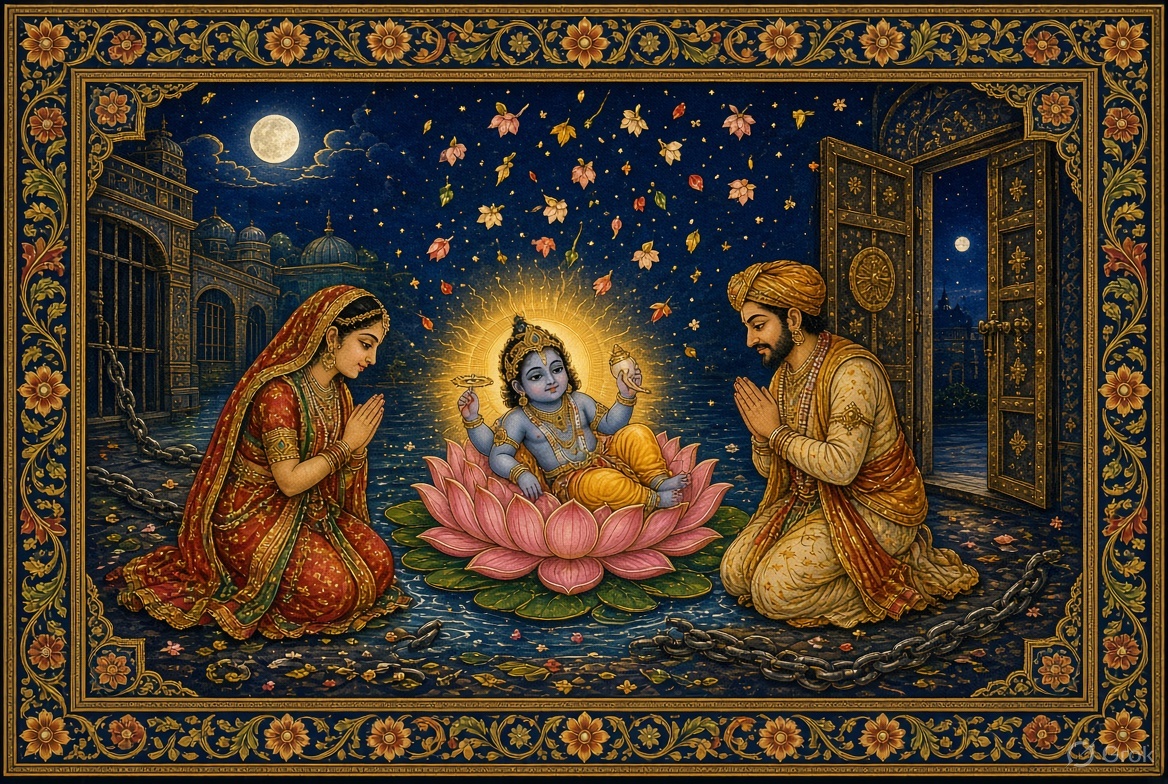
Kamsa, king of Mathura, had heard a voice from the sky on his sister Devaki’s wedding day: her eighth child would be his death. He threw Devaki and her husband Vasudeva into a stone prison and killed every child born to them. On a storm-dark Ashtami night in Bhadrapada, the eighth child arrived — first as four-armed Vishnu, then as a radiant baby boy.
The prison doors unbolted themselves. The guards slept as if struck by yoga-nidra. Vasudeva placed the child in a basket and walked into the flooded Yamuna. The river parted to his knees. The thousand-headed serpent Shesha rose as a hooded umbrella against the rain. Across the water, in Gokul, Yashoda had just given birth to a daughter. Vasudeva laid Krishna beside her and carried the girl back to the cell. At dawn Kamsa seized the infant — and she slipped from his hands, rose as Yogamaya, and warned him that his slayer already lived.
Thus the Lord who contains the worlds entered the world as a prisoner’s son, and was raised as a cowherd’s child.
The teachingThe Divine does not wait for palaces. It arrives in the darkest room, crosses the wildest river, and hides in the most ordinary home.
Leela II
Putana, the Poisoned Nurse
पूतना वध लीला
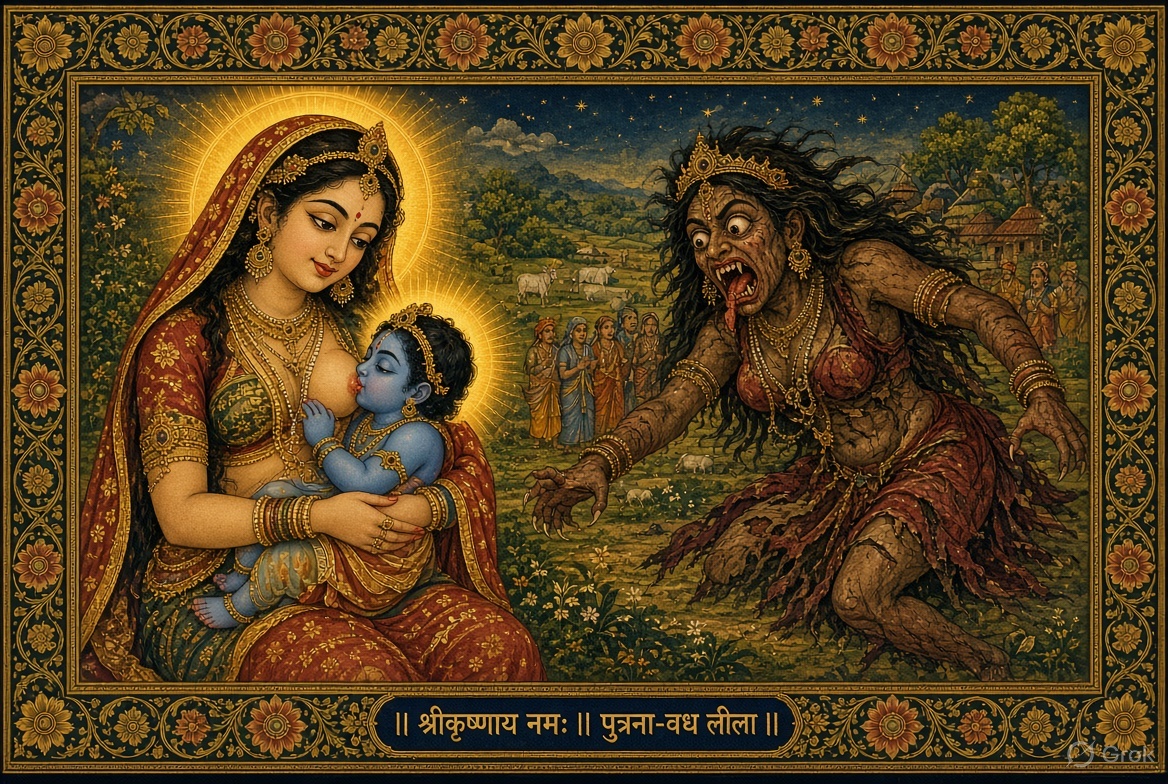
Kamsa sent the ogress Putana to hunt newborns. She smeared her breasts with a poison that could kill a grown warrior, took the form of a lovely wandering nurse, and walked into Gokul. The women of Nanda’s house, charmed by her beauty, let her lift the infant Krishna.
The child closed his mouth on her breast and drank. He drank the milk, the poison, and the life that hid behind them. Putana screamed, swelled to her true size — a monstrous body stretching across the fields — and fell dead. The villagers cut the corpse and burned it. The smoke smelled of sandalwood. Because she had offered her breast, even in hatred, Krishna granted her the destiny of a mother: liberation, and a place among those who had nursed him.
The teachingIntention may be poison; contact with the Divine still transforms it. Nothing that truly touches Krishna remains what it was.
Leela III
The Butter Thief
माखन चोर लीला
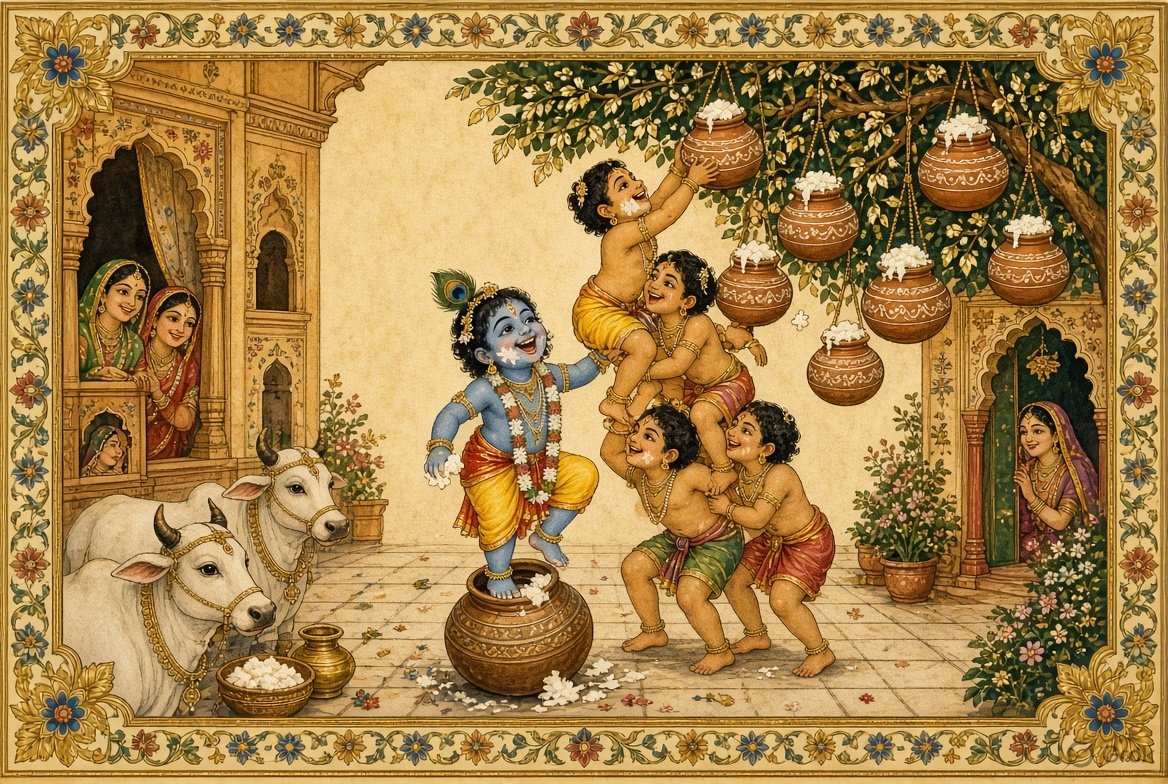
In Gokul the clay pots of butter hung from rafters, out of the reach of children and cats. They were not out of Krishna’s reach. He gathered the cowherd boys and they built living pyramids. The smallest climbed the shoulders of the rest, broke the string, and the white butter rained down. Krishna’s face was always smeared with it. He fed the monkeys first, then his friends, and only then himself.
The gopis complained to Yashoda, not entirely in anger. They wanted an excuse to stand in her courtyard and look at the child. Yashoda would scold him, and he would open eyes so large that the scolding died in her throat. The name that stuck was Makhan Chor — spoken with the tenderness reserved for a child one cannot stay angry with.
The teachingGod steals what is already his: the stored sweetness of the heart. Devotees who complain are often the ones who leave the pot where he can reach it.
Leela IV
The Universe in a Child’s Mouth
विश्वरूप दर्शन
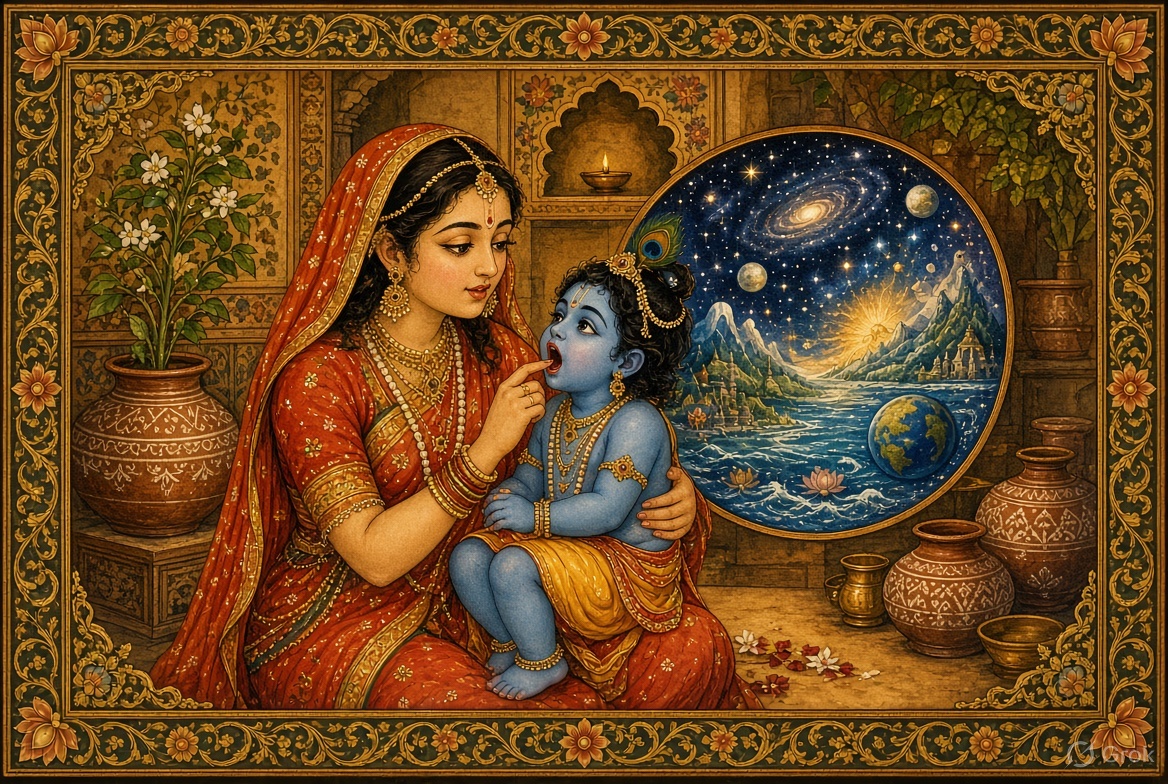
One morning the cowherd boys ran to Yashoda: Krishna was eating mud. She caught him, scolded him, and demanded he open his mouth. He refused, then smiled, then opened it.
Inside she did not see mud. She saw the sky and the earth, the circling stars, the oceans and the mountains, the forests of Vrindavan and the city of Mathura, gods and sages, time itself — and herself, standing in her own courtyard, looking into her son’s mouth. For a moment the mother who tied his hair understood that the child on her lap contained every world she had ever named.
Then Krishna closed his mouth. Yoga-maya settled over Yashoda like a soft cloth. She forgot the vision, pulled him close, and went back to being his mother. A mother who remembered the cosmos in her child every hour could not have scolded him or fed him. Love needed the veil in order to play.
The teachingThe Infinite consents to be small so that love can have a face, a name, and a lap to sit in.
Leela V
The Dance on Kaliya
कालिय दमन लीला
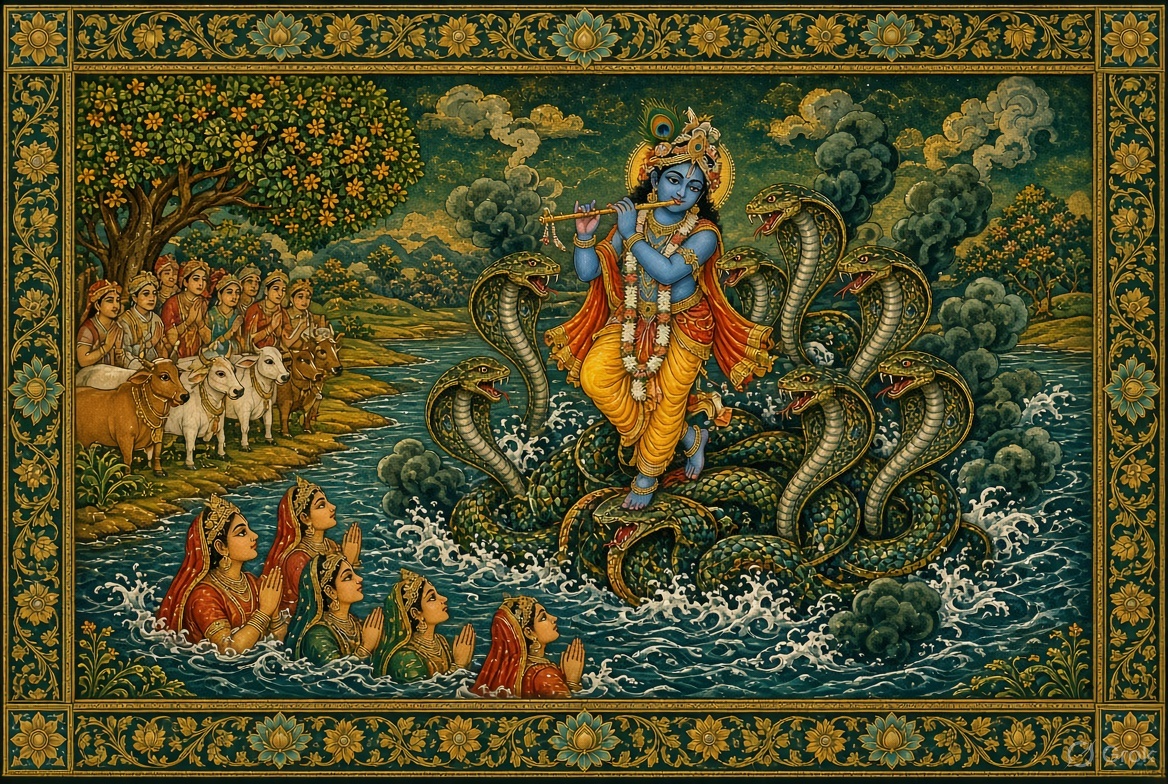
A bend of the Yamuna at Vrindavan had turned black. The naga Kaliya, driven from his island by the fear of Garuda, had taken the pool and poured venom into the water. Birds that flew over it dropped. Cows that drank staggered. Krishna, still a boy, climbed the kadamba tree on the bank and leapt.
Kaliya wound around him and dragged him under. The village gathered screaming on the shore. Then the water broke and Krishna rose, standing on the serpent’s hoods. He danced. Each step grew heavier, as if the weight of the three worlds had entered his feet. Kaliya’s heads drooped. The naga’s wives rose from the water and folded their hands: spare him, Lord.
Krishna stepped off. He sent Kaliya back to the ocean with a mark of his feet on the hoods — a mark Garuda would recognise and never strike. The Yamuna ran clear again.
The teachingPoison in the river is ego in the mind. It is not destroyed by argument. It is danced into surrender, and then allowed to live elsewhere, marked by grace.
Leela VI
The Lifting of Govardhan
गोवर्धन लीला
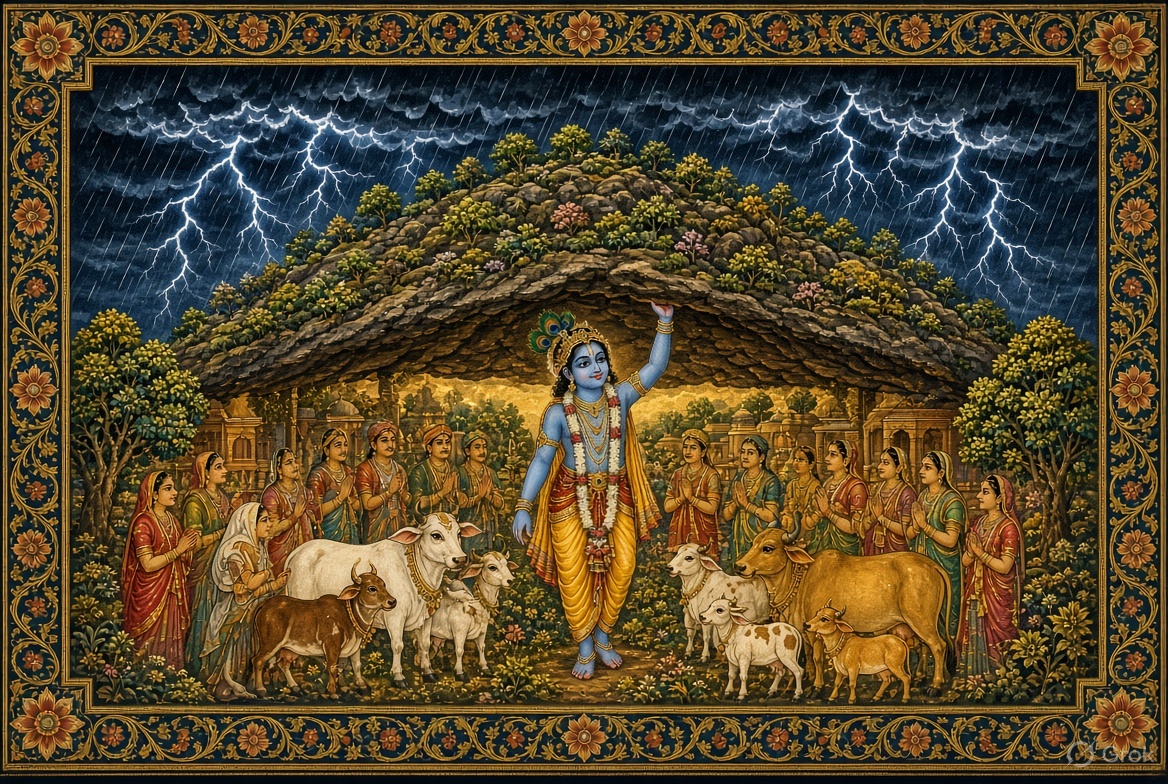
Every year the cowherds of Vraja prepared a great sacrifice for Indra. The boy Krishna asked a question that stopped the kitchen fires: Why honour the distant sky, and not the hill that actually feeds us? Govardhan gives grass, water, wood and shade. Let us worship what sustains us.
Nanda agreed. Indra, insulted, opened the clouds. Rain fell like spears for seven days. Krishna walked to the foot of Govardhan, slipped his left hand beneath a ledge of rock, and lifted the entire hill. He held it as a child holds a mushroom. The village — men, women, children, cows and calves — stood underneath for seven days and nights. No one was wet. No calf was lost.
On the eighth day Indra came down, humbled, and bowed. To this day Govardhan Puja is kept the day after Diwali: a mountain of food, and the memory of a small hand that was enough.
The teachingProtect what is near. Worship the ground that feeds you. When pride sends the storm, a single act of shelter is greater than a hundred sacrifices.
Leela VII
The Night of the Raas
रास लीला
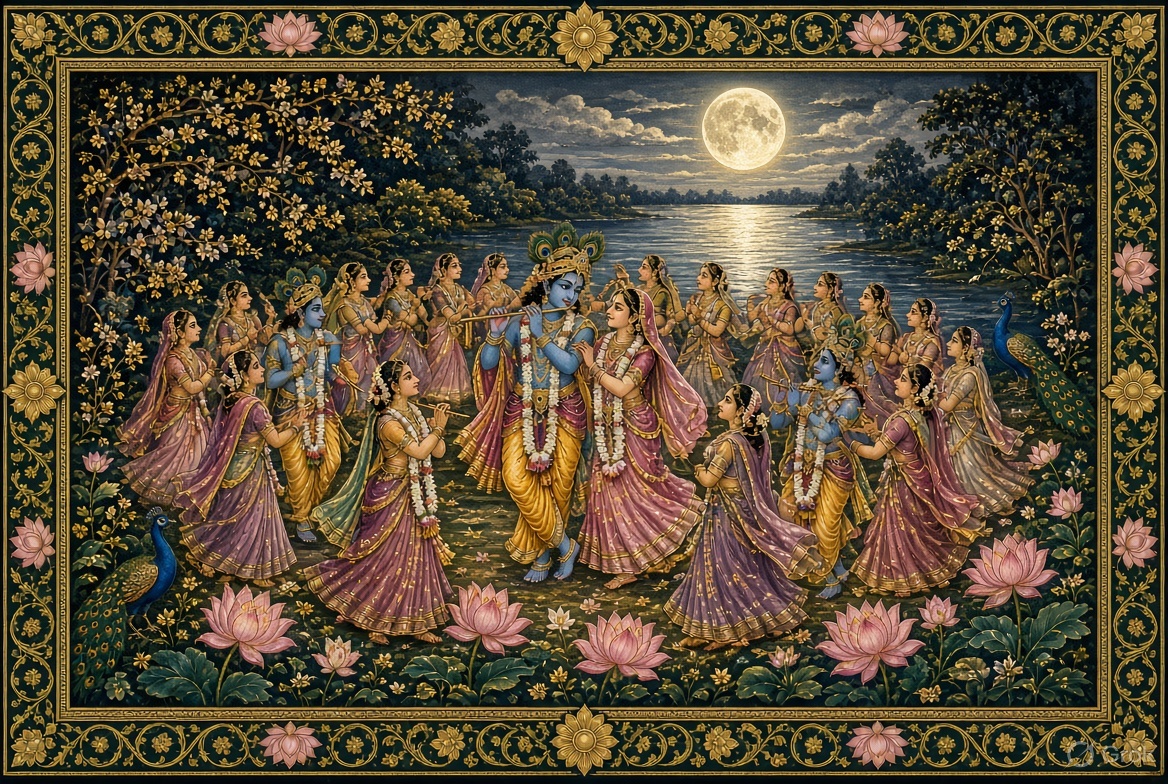
On a full-moon night in autumn Krishna walked into the forest of Vrindavan and played the flute. The notes did not travel equally. They found only the gopis — women whose work, husbands and children suddenly felt like someone else’s life. They left the houses mid-task and came to the Yamuna’s bank.
Krishna vanished once, to test whether their love was for his form or for the joy of being chosen. They searched the dark trees calling his names, and in the searching their pride burned away. When he returned he multiplied himself. Each woman danced with a Krishna who looked only at her. In the centre stood Krishna with Radha. The night, the tradition says, was stretched until every longing was answered, and not a moment longer than love required.
At dawn they went home. The pots were still unwashed. Nothing in the village had changed except the people who walked back into it.
The teachingThe Raas is not a dance of bodies alone. It is the soul discovering that the Beloved can be wholly present to every heart at once, without division and without possession.
Leela VIII
The Fall of Kamsa
कंस वध लीला
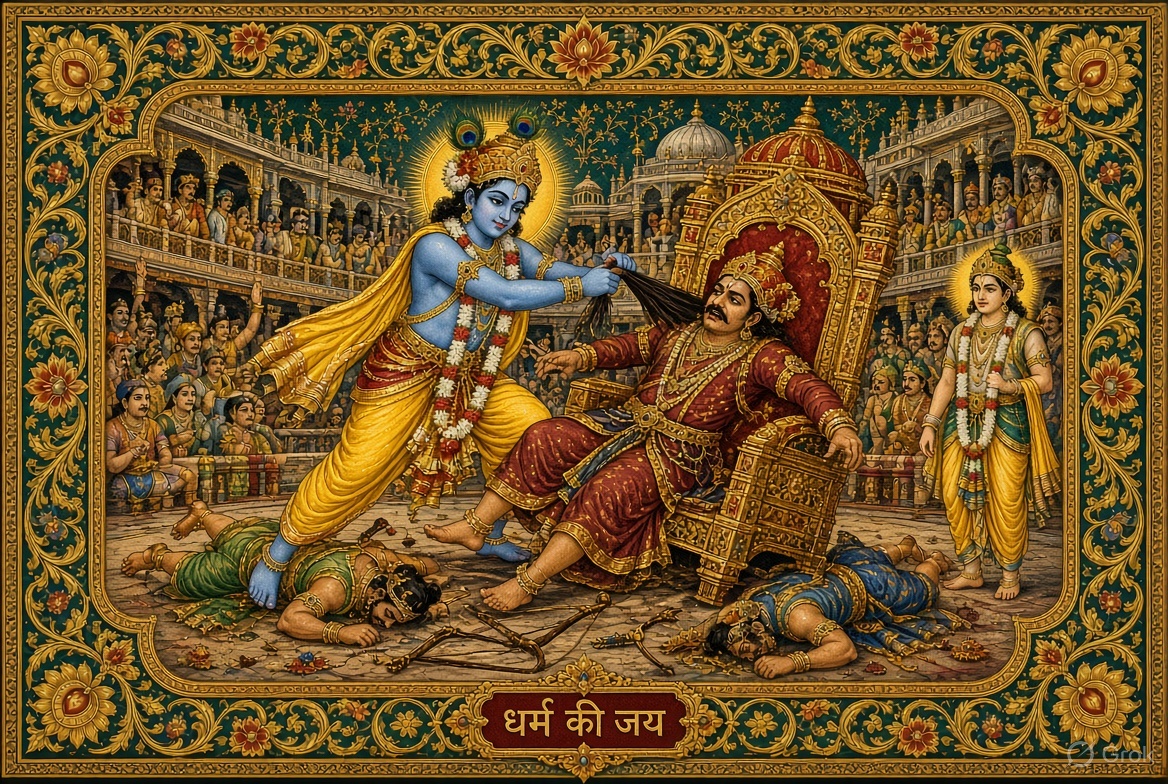
When Krishna and Balarama were still youths, Kamsa sent Akrura to Gokul with an invitation to a bow-festival in Mathura. It was a trap: the royal elephant Kuvalayapida at the gate, the wrestlers Chanura and Mushtika in the arena, and Kamsa on a high throne waiting to watch his sister’s son die.
Krishna killed the elephant with his bare hands, broke the great bow that no ordinary man could string, and stepped into the wrestling pit. Chanura and Mushtika fell. Then Krishna sprang onto the dais, caught Kamsa by the hair, and dragged him down. The king who had murdered infants died on the sand of his own arena. Krishna and Balarama bowed to Devaki and Vasudeva — still in the clothes of cowherds — and the parents who had lost seven children touched the feet of the eighth.
The prophecy spoken on a wedding day was complete. The boy from Gokul did not become king of Mathura. He placed Ugrasena on the throne and walked toward a larger story.
The teachingTyranny ends not when the frightened grow louder, but when the one who was hidden in the village finally walks into the arena and refuses to be entertainment.
Leela IX
Sudama’s Handful of Rice
सुदामा लीला
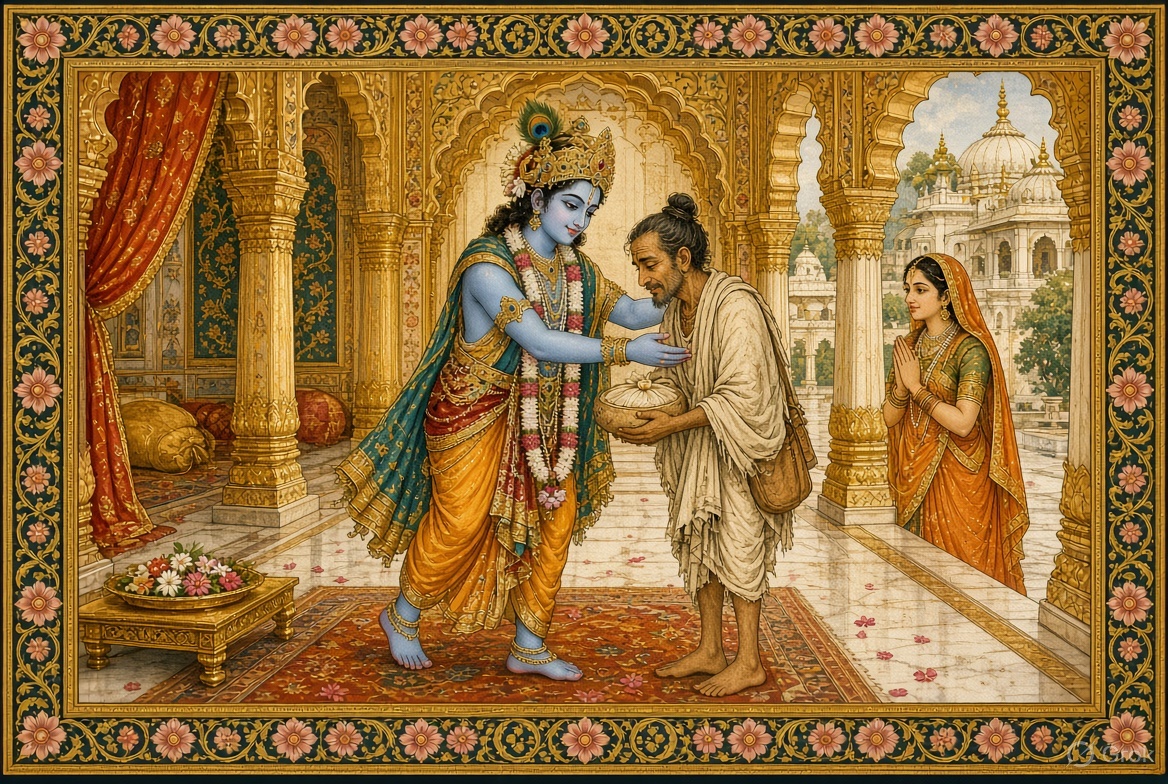
At the gurukul of Sandipani, Krishna’s closest friend was a thin Brahmin boy named Sudama. Years later Sudama lived in a hut that leaked, with a wife who ate after the children, if there was anything left. She asked him, once, to visit the friend who now ruled Dwaraka. Sudama had nothing to take. She tied four handfuls of flattened rice — poha — in a rag.
The palace guards almost turned him away. Krishna saw him from the inner hall, ran barefoot across the marble, and pulled Sudama into an embrace that left the court staring. He seated him on the royal couch, washed his feet, and asked for the gift. Sudama hid the rag, ashamed. Krishna snatched it anyway and ate a handful with the joy of a child who has found butter. Rukmini stayed his hand before the second; the tradition says a second handful would have emptied the treasuries of the earth.
Sudama asked for nothing. He walked home reciting old lessons, certain he had failed his wife. At the place where the hut had stood there was a house of light, granaries, silk, and a woman who no longer looked hungry. He understood then that the Lord does not wait to be asked by those who remember him only as a friend.
This is the leela behind the narrative bhajan Sudama ji Ko Dekhat — five minutes fourteen seconds of the same friendship, sung rather than painted.
The teachingFriendship with God is not a ladder out of poverty. It is the poverty itself carried into a palace and received as if it were the rarest offering in the world.
Told from the Srimad Bhagavata Purana as it is remembered in Vraja. Illustrations were made for this page in the spirit of Pichwai and Rajasthani miniature painting. After reading, the playlist Mere Shyam is the right next room.
Support & bookings
Help the next bhajan, or book a mehfil
UPI offerings go toward recording. WhatsApp is for satsang, temple and private bookings.