Meerabai was born around 1498 into the Rathore house of Merta — daughter of Ratan Singh, granddaughter of Rao Dudaji, raised among Vaishnavas who kept Krishna in the inner rooms. Dates in the chronicles wander by a few years; the story that the tradition kept does not.
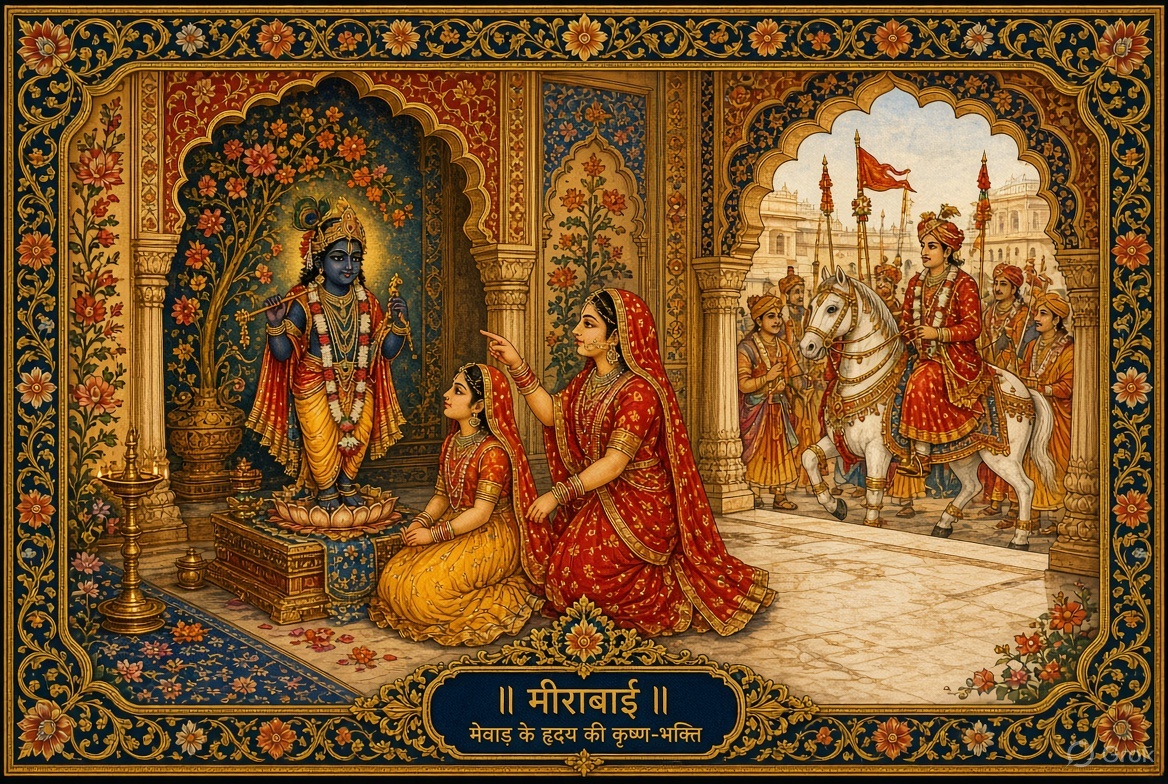
A wedding procession passed the palace. The child watched the decorated groom on horseback and asked her mother the only question that mattered: who will be mine? Half in jest, her mother pointed to the family’s idol of Krishna. The joke became a vow. Meera took the image as a living husband. She spoke to it, dressed it, slept near it. When her mother died, her grandfather brought her fully into that worship. The palace had other plans. She had only one.
The teachingA sentence spoken to a child can become a whole life. Meera never treated the pointing finger as a joke.
II · Chittorgarh
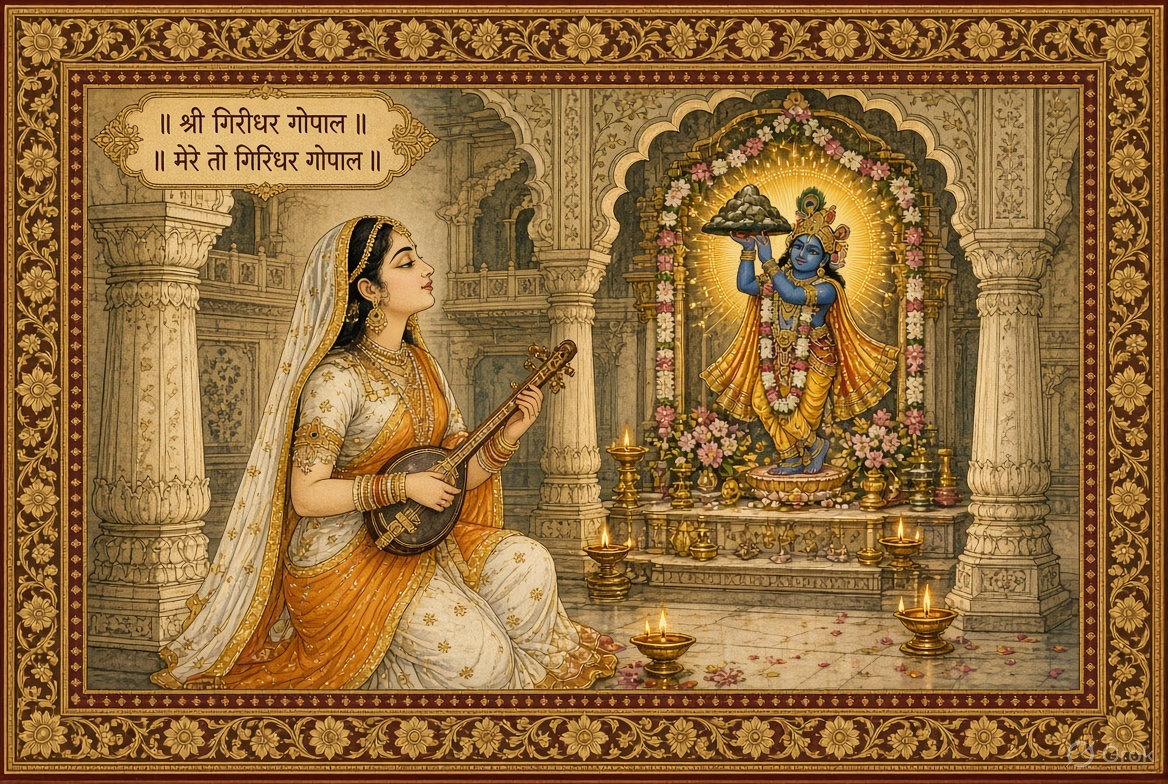
Giridhar Gopal, and no other
मेरे तो गिरिधर गोपाल, दूसरो न कोई
In 1516 she was married into Mewar — to Bhoj Raj, eldest son of Rana Sanga, the Sisodia prince of Chittor. Older English writers sometimes named the husband Rana Kumbha; the court record that most historians now follow is Bhoj Raj. She did the work of a princess. When the work was finished she went to the temple and sang.
Bhoj Raj was wounded in the wars with the Delhi Sultanate and died around 1521. Rana Sanga fell after Khanwa. The young widow was expected to shrink: austerity, silence, perhaps the fire. She did the opposite. She kept the company of sadhus, danced before Giridhar, and wrote pads that still travel in Rajasthani and Braj — Mere to Giridhar Gopal, doosro na koi. The court heard a scandal. She heard a marriage that had already been performed in childhood.
The teachingThe world can arrange a wedding. It cannot unmake a name already given to God.
III · The palace tests
Poison that became amrit
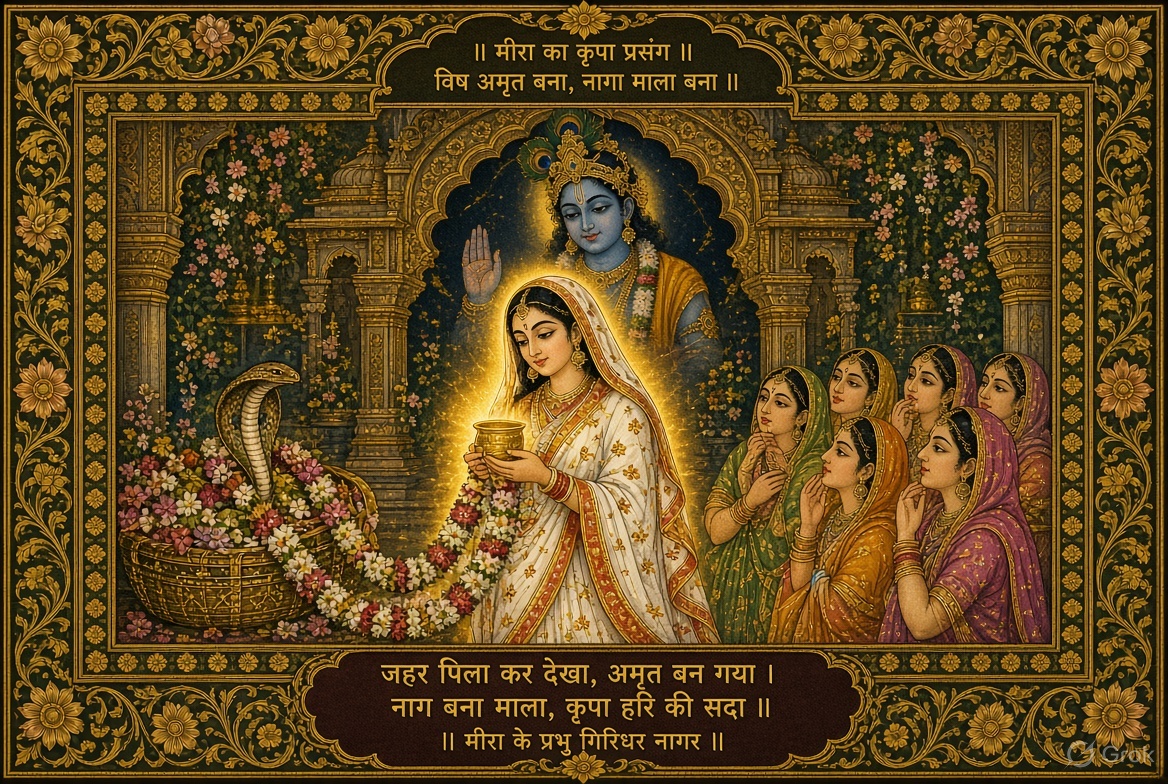
विष अमृत बना
The legends of Chittor are consistent even where the chronicles are thin. A cup of poison was sent as prasad. Meera drank it as Krishna’s gift; it sat in her as nectar. A basket said to hold flowers held a cobra; the snake became a garland, or would not strike. A bed of nails, a locked temple — the versions multiply. What they agree on is the shape of the conflict: a royal house trying to recover a daughter-in-law, and a woman who would not come back from the sanctum.
Whether every attempt happened as later singers told it matters less than what the tradition insisted on remembering: Krishna stood between Meera and the palace. The pads from these years are not polite. They name the in-laws. They also name Giridhar as the only protection worth having.
The teachingDevotion that costs nothing is a hobby. Meera’s bhajans were written on the far side of a locked door.
IV · Vrindavan
The road that left the fort
ब्रज की धूल
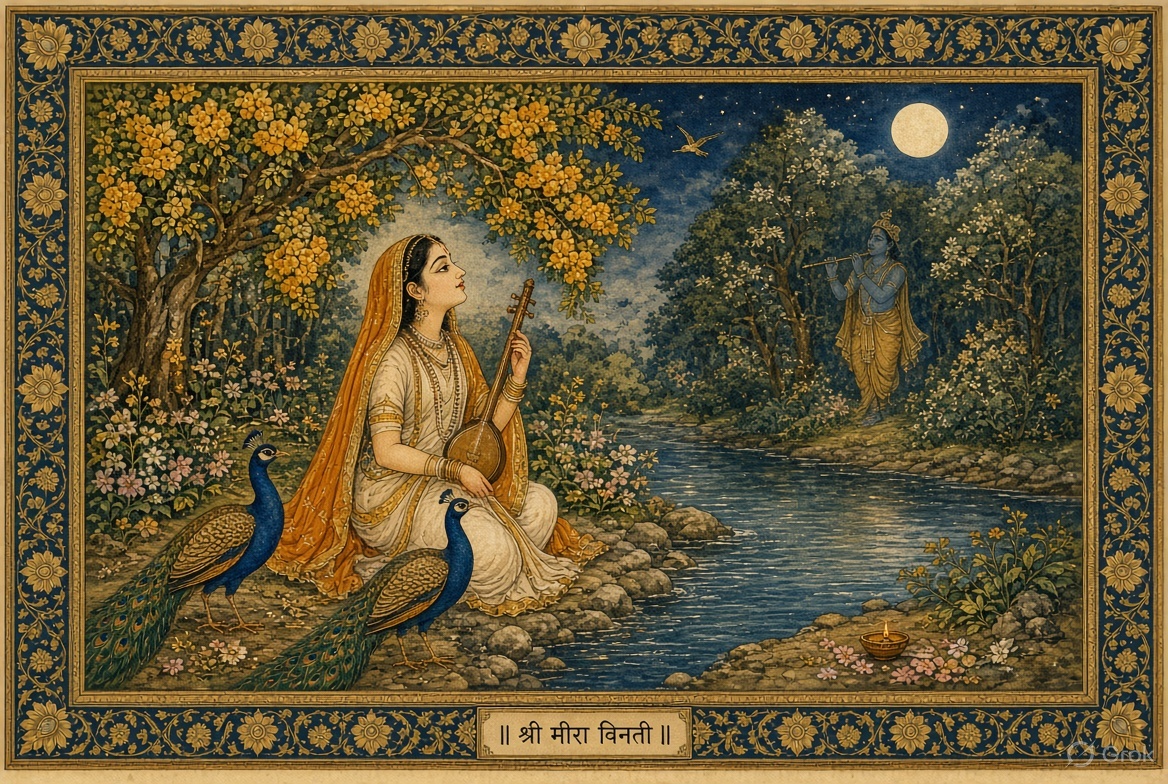
She left Chittor. Some tellings send her first back to Merta, then out as a pilgrim when war closed even that house. Vrindavan received her the way it receives anyone who arrives with a name of Krishna and nothing else. The later tradition places her among the Goswamis — a meeting with Rupa Goswami is often told — and on the Yamuna’s bank with an ektara.
The pads from the road are lighter and more piercing at once. Palaces fall out of the verses. Dust, kadamba, the flute heard and not quite seen — that is the furniture that remains. A princess had become what she had always claimed to be: a woman walking toward a husband who would not die in battle.
The teachingLeaving is also a form of singing. The voice that could not be kept in Chittor found the right street in Braj.
V · Dwarka
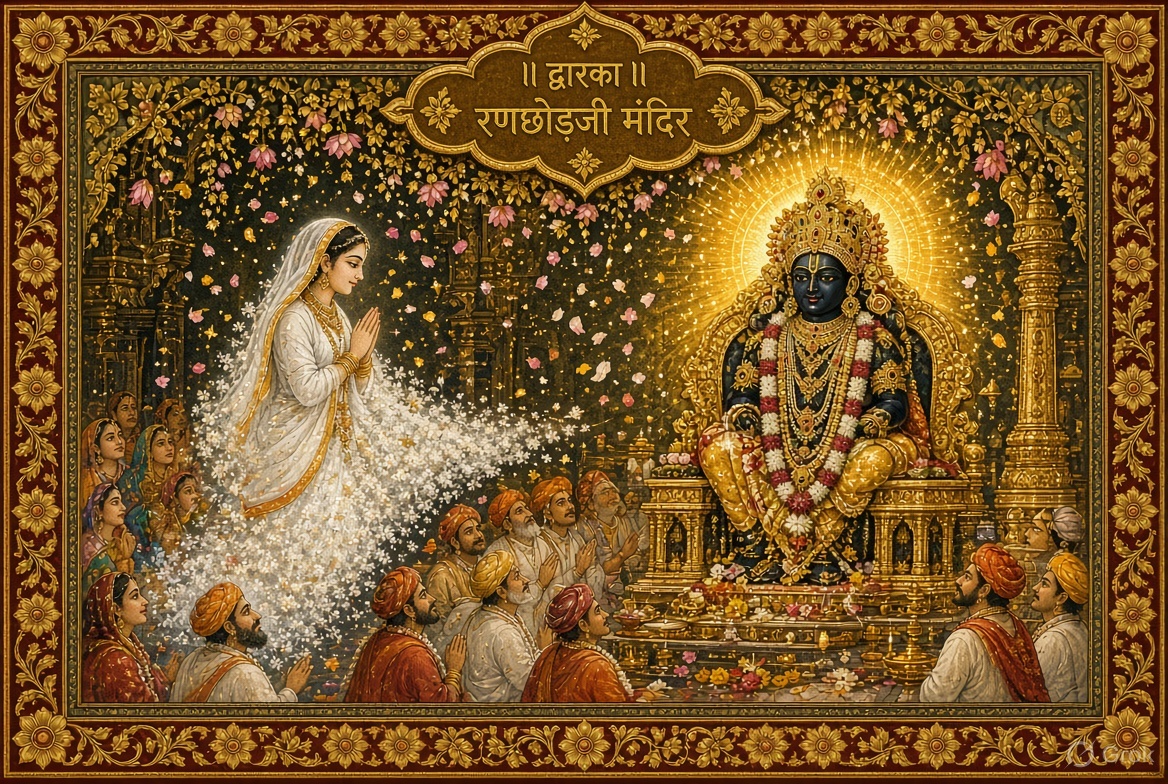
The last song at Ranchhodji
द्वारका में विलय
The end that the tradition keeps is not a funeral. Around 1546 Meera came to Dwarka, to the temple of Ranchhodji — Krishna as the one who left the battlefield of Mathura to keep a larger promise. She asked to be left alone with the image. She sang. When the doors were opened the singers say her body was gone, or only her veil and the ektara remained, and the idol shone as if it had taken her in.
History cannot prove a merging. It can only note that a life which began with a finger pointed at an idol ended, in memory, inside one. The pads survived the woman. They are still sung in the same throat that sings Shyam on this site — a princess addressing the same listener.
The teachingSome lives do not conclude. They change address. Meera’s last forwarding address was the dark face in the sanctum.
Told from the Bhakti tradition as it is remembered in Rajasthan and Vraja. Dates follow the common scholarly window (c. 1498–1546). The illustrations were made for this page in the spirit of Pichwai and Rajasthani miniature painting.
Support & bookings
Help the next bhajan, or book a mehfil
UPI offerings go toward recording. WhatsApp is for satsang, temple and private bookings.