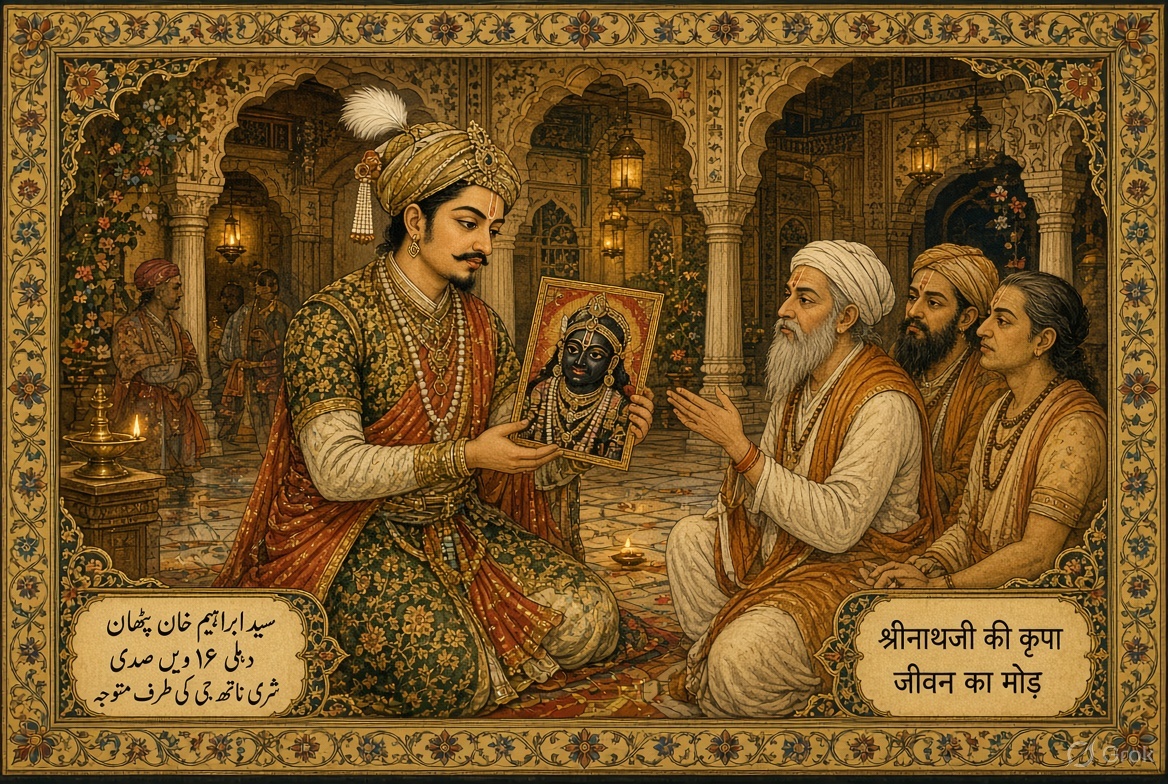
He was born Syed Ibrahim Khan around 1548 — a Muslim of Pathan descent, raised in comfort near Delhi, or in Pihani, depending on which scholar is counting. The family had land. The son had time. The early stories give him an intense worldly attachment, then a conversation with Vaishnavas who told him that the love he was wasting on a face could be spent on a face that does not age.
They showed him a painting of Shrinathji — Krishna as the child who lifted Govardhan, dark, jeweled, standing with one hand raised. Ibrahim kept the picture. He took an oath that is still repeated in Braj: he would not eat until he had seen that form with his own eyes. A prosperous youth became a man walking toward Vrindavan with a hunger that was no longer metaphor.
The teachingSometimes bhakti does not begin in a temple. It begins when a picture is more alive than the room it is held in.
II · The closed door
Three days on the bank
मंदिर के बाहर
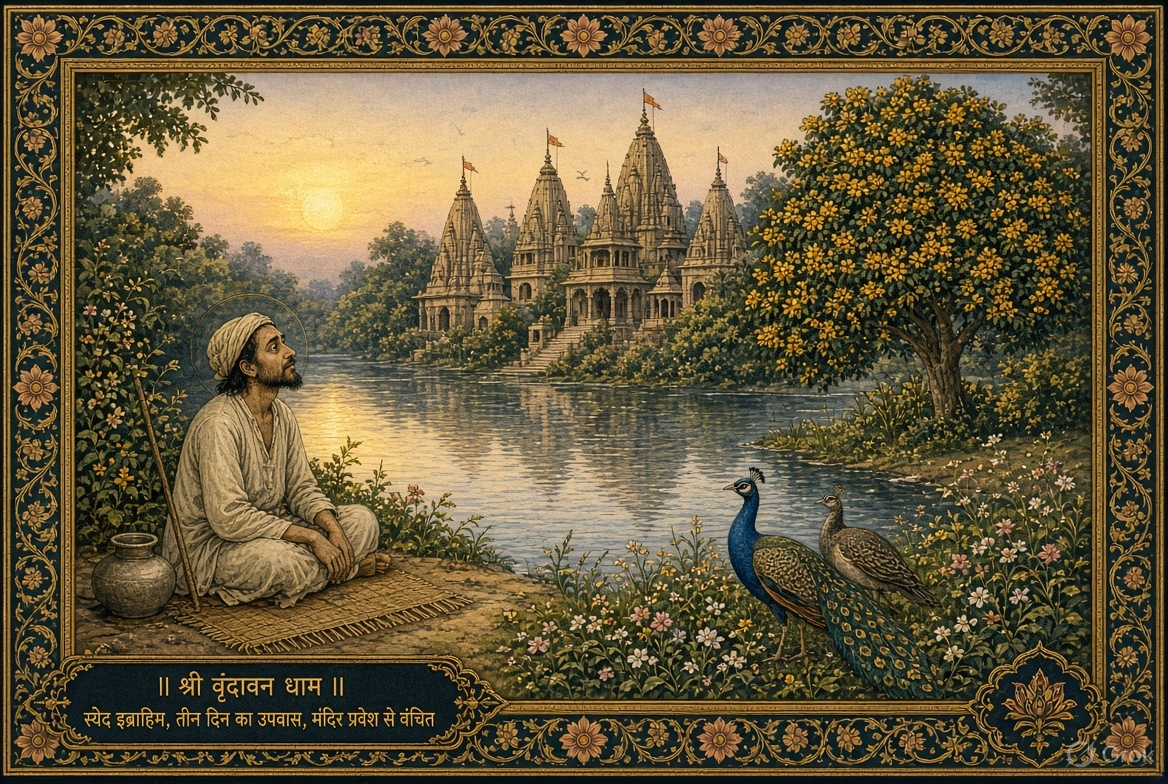
Vrindavan did not open at once. The telling that has lasted is blunt: a Muslim at the temple step was turned away. Ibrahim sat by the water near the shrine, ate nothing, drank little, and waited. Peacocks walked. Pilgrims passed. The door stayed a door.
Three days is the number the singers use — long enough for pride to finish, short enough that the body is still there when grace arrives. He had already given up a household. Now he gave up the last argument: that he was owed entry because his longing was sincere. Longing waited outside with him.
The teachingThe threshold is part of the pilgrimage. Some devotees are named only after the door has done its work.
III · The naming
He called him Raskhan
नामकरण
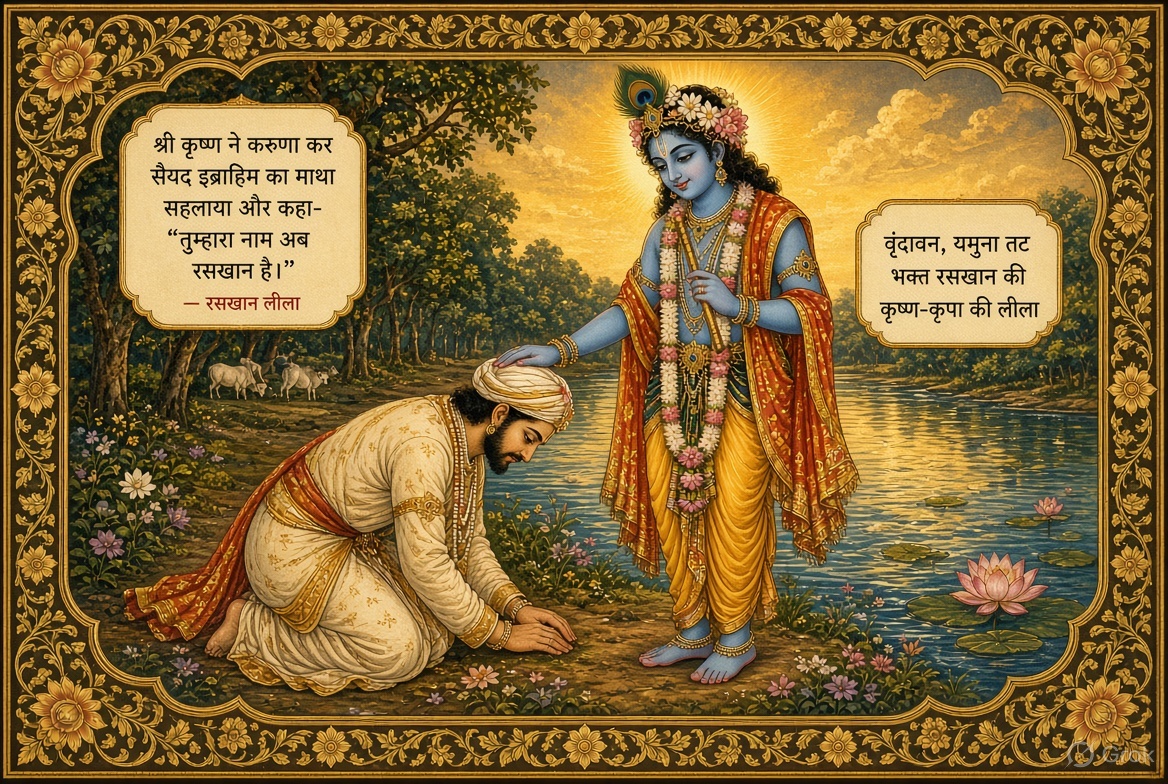
The story says Krishna came to the bank. Not as an argument, as a boy with a flute. He put his hand on Ibrahim’s head and gave him the name the verses still carry: Raskhan — a mine of rasa, a hoard of the juice of devotion. The door that had been closed was no longer the point. The one who names does not need a committee of priests.
From here the biography and the poetry become the same document. He took initiation in the Vallabha line from Vitthalnath, son of Vallabhacharya, and stayed in Braj. The Pathan did not write a treatise on conversion. He wrote savaiyas about a dark boy stealing butter and standing on a mountain.
The teachingA name given by Krishna is not a costume. It is the life that follows the hand on the head.
IV · Braj Bhasha
Prem Vatika and Sujan Raskhan
प्रेम वाटिका
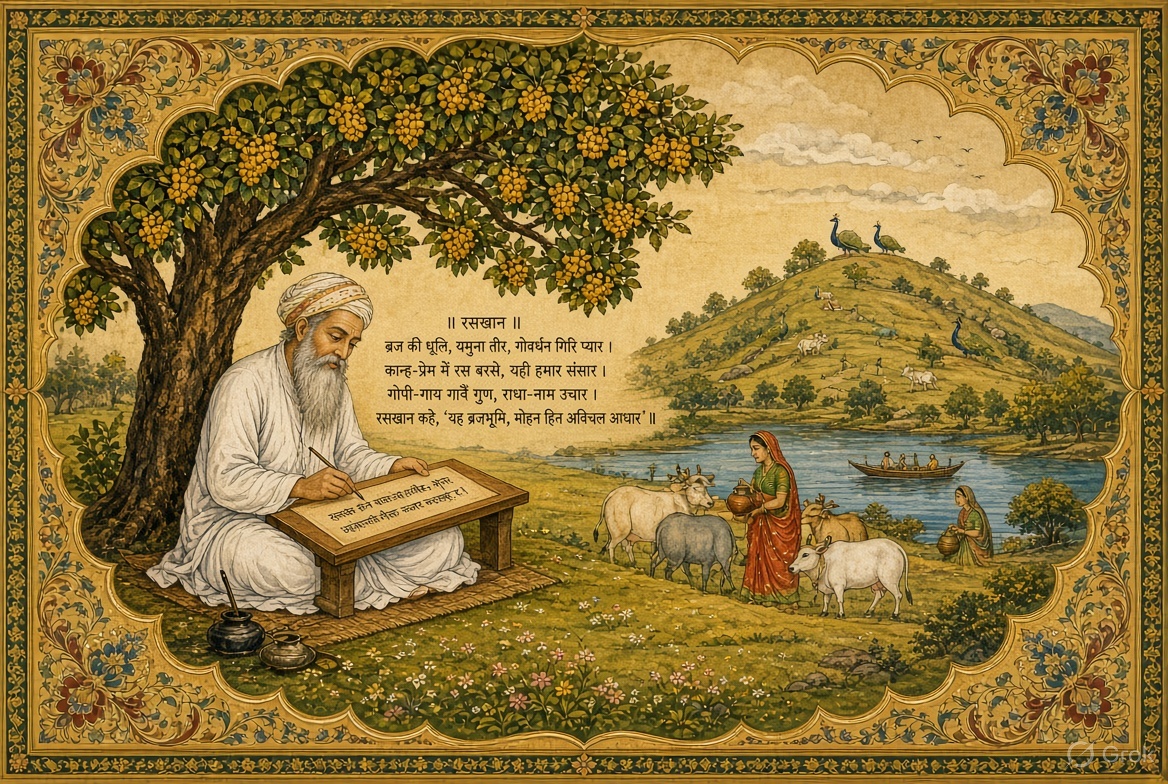
The books that remain are small and inexhaustible. Prem Vatika — a garden of love — walks the leelas: childhood, the flute, the gopis, the dust of Braj. Sujan Raskhan keeps the same heat in savaiya and kavitta. He wrote that he had looked for Krishna in scriptures and pilgrimages and found him at last at Radha’s feet. The line is theology and autobiography in one breath.
He loved the land as much as the Lord of the land. Cows, Yamuna, Govardhan, the particular tree — the poems refuse to be only ideas. A man who had left Delhi did not write about Delhi. He wrote as if the only address left in the world were a bend of the river and a boy who might still be there.
The teachingBhakti that cannot describe a tree has not yet arrived. Raskhan’s Krishna always has a landscape.
V · Mahaban
The samadhi by the old road
महाबन समाधि
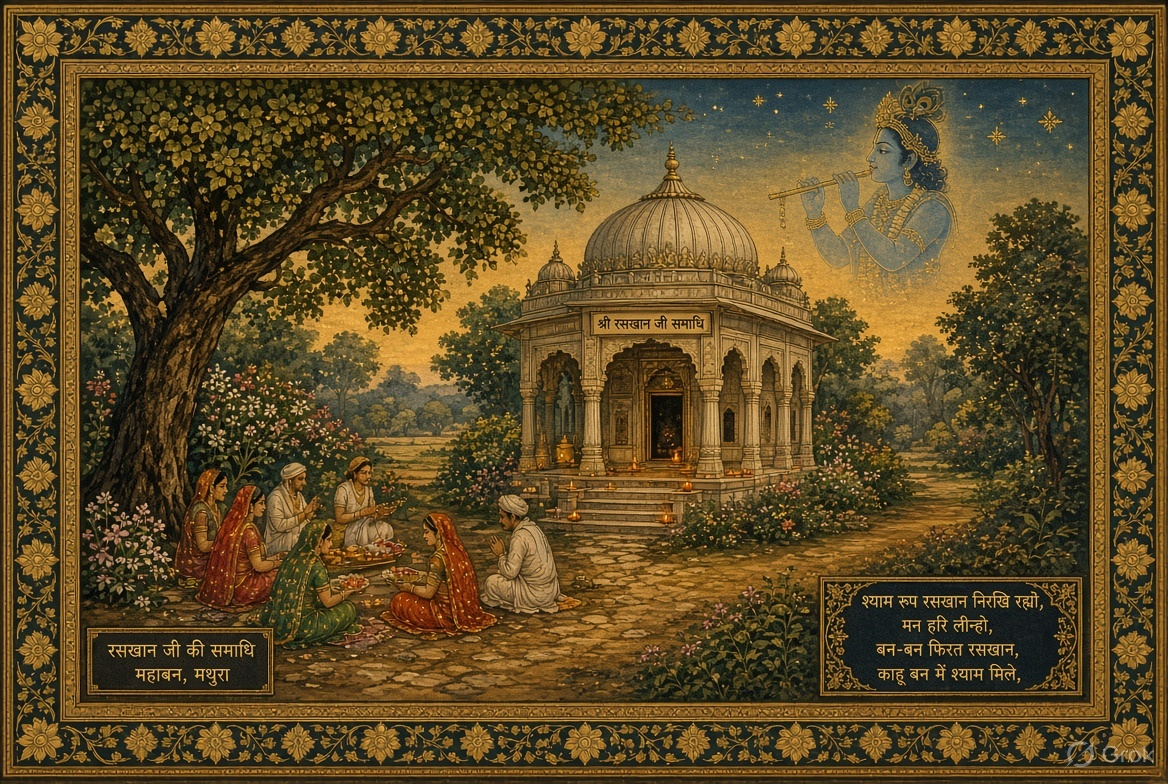
In 1628, the tradition says, he left the body in Braj. The samadhi stands at Mahaban, a few miles east of Mathura — a quiet shrine where devotees still sit. The man who was refused a doorway was kept, at the end, inside the geography he had chosen.
Hindi classrooms still teach the savaiyas. Temples in Vraja still say the name without a footnote. For a music house that sings Shyam, Raskhan is not a curiosity from another religion. He is proof that the flute does not check the papers at the gate. It checks whether anyone is still listening after three days of hunger.
The teachingThe last address of a bhakta is not a biography. It is a place on a map where other thirsty people can still sit down.
Told from the Braj tradition and the received lives of Syed Ibrahim / Raskhan. Birth and death years follow the common window (c. 1548–1628). Illustrations were made for this page in the spirit of Pichwai and Rajasthani miniature painting.
Support & bookings
Help the next bhajan, or book a mehfil
UPI offerings go toward recording. WhatsApp is for satsang, temple and private bookings.